You are here: > ACCUTON > faq's


frequent asked questions:

The most frequent questions and answers about ACCUTON ceramic drivers:


- Do you have any relation with the US - based THIEL company?

- Are you really the only one to manufacture ceramic drivers?

- Are ceramic domes very fragile?

- How is efficiency of ACCUTON drivers?

- What is the difference between your drivers and usual tweeters?

- What is the purpose of those "ears" at the edge of the ceramic membrane?

- Why do you use ferrofluids in your drivers?

- Can you make a bass driver with higher excursion?

- Is it possible to use first-order filters with ACCUTON units?

- What is the difference between C²78 and C²79?

- How do you read the item number?


Do you have any relation with the US - based THIEL company?
No, not at all. The inventor of the ceramic membranes is called Bernhard Thiel. This name "Thiel" is quite common in Germany and we have a simple equity of names here with the american born Jim Thiel. Our loudspeaker boxes carry the brand name "MUSICA" to prevent any mix-up. The ceramic drivers are brand-named "THIEL & PARTNER" in Europe, "ACCUTON" in North-America and sometimes "VENTEC" in Far-East. They all come from the same factory in Bexbach, Germany.

Are you really the only one to manufacture ceramic drivers?
Yes, THIEL & PARTNER is the one and only company to produce real ceramic cones. We have seen other companies claiming to have ceramic membrane tweeters (only those) but this is bogus material and not pure corundum. These membranes usually have an undefined white powder coating on an aluminum cone and do not carry the physical properties of our ceramic units. The features and benefits of a real corundum membrane cannot be accomplished by these "so-called" ceramic units.

Are ceramic domes very fragile?
Built into the drive unit, they are not. With a clean, appropriate music signal, you definitely cannot destroy them. Even more, they will last longer than any other unit because the membrane material will not weaken in time. Treated carefully, even your grandchildren will still love them. Despite the fact that our ceramic membranes are very thin, (50 microns the tweeters and 100 or 150 microns the midrange- and bass-units) they do not break under normal listening conditions. Actually, after we had equipped our drivers with a strong protection grid, claims of broken domes dropped to almost zero.

How is efficiency of ACCUTON drivers?
Due to the concave shape and the pure piston movement, ceramic drivers have an extremely widespread energy distribution and therefore a lower on axis sound pressure. The good thing is that this will widen your "sweet spot" enormously and give an equal and filling sound all over your listening room. It is therefore recommended to adjust the amplitude curve of a loudspeaker system to be flat or even slightly dropping to the higher frequencies to achieve an even energy distribution. Hence, you have to compare our tweeters to units with on axis pressure that is 2-3 dB higher.
We use fairly small (and lightweight) voice-coils for our drivers that require a hole in the pole piece. If this is too small, we suffer cavity resonances and a raised resonant frequency. Is it too big, the pole piece saturates too early and this restricts magnetic flux. We therefore have to find a compromise either towards efficiency or towards sound quality. We have always chosen sound quality.

What is the difference between your drivers and usual tweeters?
Cheap tweeters use the same material (cloth, silk, aluminum, titanium or whatever) for both, surround and membrane, which is easy and inexpensive to manufacture. It is not smart however, since membrane and surround serve completely different functions in a driver. On top of that, at higher frequencies, parts of the membrane decouples from sound radiation. This gives higher on-axis sound pressure but unwanted phase shift and worse energy distribution than with ACCUTON drivers.
Ceramic membranes work - unlike others - like an ideal piston over the entire recommended frequency band. This is due to the fact that we use an extremely hard membrane material that doesn't bend and a soft fabric surround that yields an undisturbed and phase-stable piston-like motion. The concave shape of our ceramic dome gives a better distribution pattern than usual tweeters have and much lower distortion.
It's in essence the design of a minute bass driver. Needless to say that all components that we use are of the best quality material we can get. The frontplate - for example - is made of heavy, acoustically inert zinc instead of plastic or aluminum. We are using up to five times more parts than in conventional tweeters and it takes more than one hour assembly time to make an ACCUTON unit.

What is the purpose of those "ears" at the edge of the ceramic membrane?
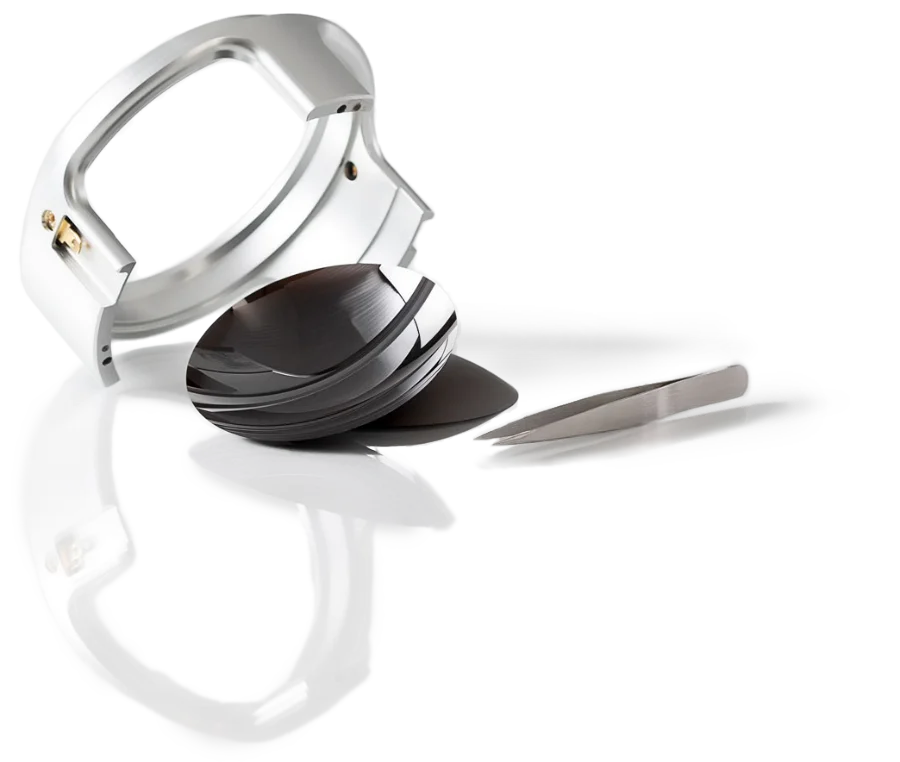
All hard membranes tend to have break-up modes. Without the "ears" we would have strong peaks at the upper end of the driver bandwith. Although this happens well above the audible range - for C²12 above 35 kHz and for C²23 above 27 kHz - we don't like the idea of these peaks interfering with lower audible frequencies. The "ears" are a very efficient method to damp membrane resonances and to cancel these unwanted peaks. Yet they are very difficult and costly to manufacture and this is the reason why nobody else does it. The small "ears" of the tweeters are assembled under large binoculars to ensure the correct position.

Why do you use ferrofluids in your drivers?
Some people are preocupied about ferrofluids, but probably they don't know that there are more than 50 variations (and qualities) and different viscosities for each one. Choosing the right type and quantity is an art and can improve the performance of a driver significantly. The type we are using is of very low viscosity and will not slow the driver's rise time - as you can see from our step response measurements - but improve the decay and distortion.
The ferrofluid forms a pneumatic seal between the inner and the outer rear chamber to present a symmetrical air-load to the ceramic membrane. The power handling capacity is more than doubled and the resonance peak of the impedance curve becomes almost invisible. The decay of the driver and it's distortion is also dramatically improved.
We would love to save the very expensive ferrofluid but we would sacrifice sound quality this way.

Can you make a bass driver with higher excursion?
Of course we could. Nevertheless, we don't think it would be wise. Our 7-inch bass drivers of the C²92 and C²94 series have an Xmax of ± 4,0 mm, C²95 series ± 5,0 mm, which is ideal for units of this size. Expanding Xmax would sacrifice other performance data for an excursion that is needed only for a very small percentage of time of your normal listening conditions. To improve bass performance it is much better to stack 2 or more bass units to enlarge the radiating surface area. With our high impedance bass-drivers with up to 32 Ohms, this can be done in parallel wiring for up to 8 units.

Is it possible to use first-order filters with ACCUTON units?
Yes, our drivers are idealy suited for first-order filtering since they cover a very wide bandwith in a linear and piston like motion. Even the tweeters and midrange units are capable of unlikely high excursions and have a high power rating. An extremely low and well damped resonance peak requires usually no or very little equalization. We do recommend first order filtering for both, active and passive loudspeaker boxes.

What is the difference between C²78 and C²79?
We designed a successor to our famous midrange C²77 that is no longer available and introduced C²78 and later C²79 with a slightly improved surround. Some of our clients still prefer the earlier C²78 - so this unit is manufactured on request. The difference is just in the surround so we did not add a special leaflet for this unit.

How do you read the item number?
The item number gives you all the information about the mechanical design of the unit. It contains the size of the basket being used, the voice coil, the magnet and the resonant frequency, all separated by a dash. Lets take an example:

- item number #C220-A7/50/16/2-6F140/20-R35

This means: Ceramic membrane in a 220mm basket, on an Aluminum former a voice-coil of 7 Ohm impedance, 50mm diameter, 16mm height with 2 layers. The magnet system has a 6mm pole plate and a Ferrite ring of 140mm diameter and 20 mm height. The driver finally has a high loss Rubber surround and a resonant frequency of 35 Hz.